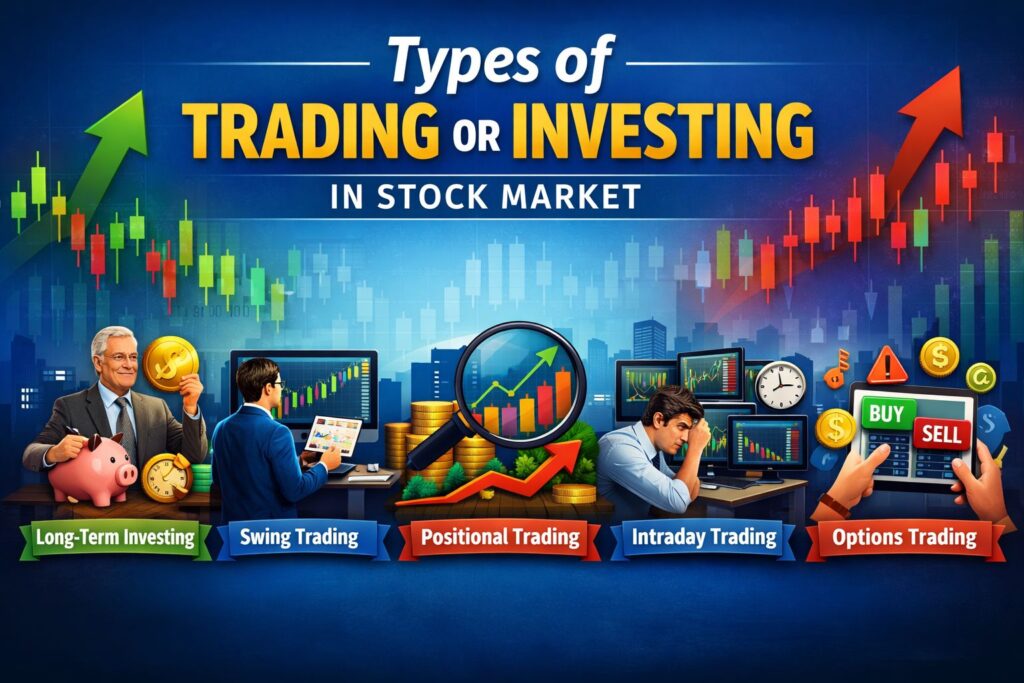
The stock market is a network of exchanges and markets where investors buy and sell shares of publicly traded companies. It functions as a primary engine of the global economy, enabling companies to raise capital and allowing investors to own a portion of a business. Prices are driven by supply and demand, influenced by company performance, economic data, and investor sentiment. Key Indian exchanges include the NSE – NIFTY 50 and BSE – SENSEX.
1. Stock Market Definition: The Basics
At its core, the stock market is a collection of public markets where shares of companies are issued, bought, and sold. Think of it as a giant, global marketplace for ownership. When you buy a stock (or share), you’re purchasing a small piece of that company. If the company grows and becomes more valuable, your piece becomes more valuable too. When learn about Stock Market Trading accounts act as a vital role in Stock Market Investing
2. How Does the Stock Market Work?
The stock market operates on two primary levels:·
Primary Market: Where companies first sell shares to the public through an Initial Public Offering (IPO) to raise capital.
Secondary Market: Where investors trade those existing shares among themselves on exchanges like the NSE-National Stock Exchange, BSE-Bombay Stock Exchange
3. Key Players in the Stock Market
- Investors & Traders: Individuals and institutions buying/selling shares
- Brokers: Intermediaries who execute trades (e.g., Zerodha, Groww, Angelone).
- Exchanges: The platforms where trading happens (NSE (https://www.nseindia.com/ ), BSE (https://www.bseindia.com/?)).
- Regulators: Entities like the SEC (Securities and Exchange Commission) that ensure fair and transparent operations.
4. Why Does the Stock Market Exist? Its Core Functions
- Capital for Companies: Provides businesses funds to grow, innovate, and hire.
- Wealth Creation for Investors: Offers a chance to grow savings and build wealth over time.
- Economic Indicator: Serves as a barometer for the overall health of the economy.
5. Common Stock Market Terms Explained
- Bull Market: A period of rising prices and optimism.
- Bear Market: A period of falling prices and pessimism.
- Portfolio: Your collection of investments.
- Dividend: A portion of a company’s earnings paid to shareholders.
- Index: A measurement of a section of the market (e.g., NIFTY 50, SENSEX 30 ).
6. How to Start Investing in the Stock Market
Educate Yourself: You’re already doing this!
Define Your Goals: Are you saving for retirement, a house, or long-term growth?
Choose a Brokerage Account: Select an online broker that fits your needs.
Start Small & Diversify: Consider low-cost index funds or ETFs to spread risk.
Think Long-Term: The stock market has historically trended upward over long periods, despite short-term volatility.
Frequently asked questions:
Q1: What is the stock market in simple terms?
A: In simple terms, the stock market is like a giant, global auction house for buying and selling tiny pieces of ownership in companies. These pieces are called “stocks” or “shares.” If a company does well, the value of your piece can go up. If you sell it for more than you paid, you make a profit.
Q2: How do you make money from the stock market?
A: There are two primary ways to make money:1. Capital Gains: This is the most common way. You buy a stock at one price and sell it later at a higher price. The profit is your capital gain.2. Dividends: Some companies regularly pay out a portion of their profits to shareholders. These cash payments are dividends, providing income even if the stock price doesn’t move much.
Q3: Is the stock market gambling?
A: No, but it carries risk, which is why the comparison arises. The key difference is ownership and information.· Gambling (like roulette) is a zero-sum game based on random chance. You own nothing.· Investing means you own a share of a real business that produces goods, services, and profits. While prices can be volatile, long-term investing is based on the growth of the economy and companies, not pure chance. Research and strategy can improve outcomes.
Q4: What are bull and bear markets?
A: These terms describe long-term trends:· Bull Market: A prolonged period (typically months or years) of rising stock prices, generally by 20% or more from recent lows. It’s associated with economic growth and investor optimism.· Bear Market: A prolonged period of falling stock prices, generally a decline of 20% or more from recent highs. It’s associated with economic slowdowns and investor pessimism.
Q5: What is NSE and BSE?
A: NSE – National Stock Exchange, BSE – Bombay Stock Exchange