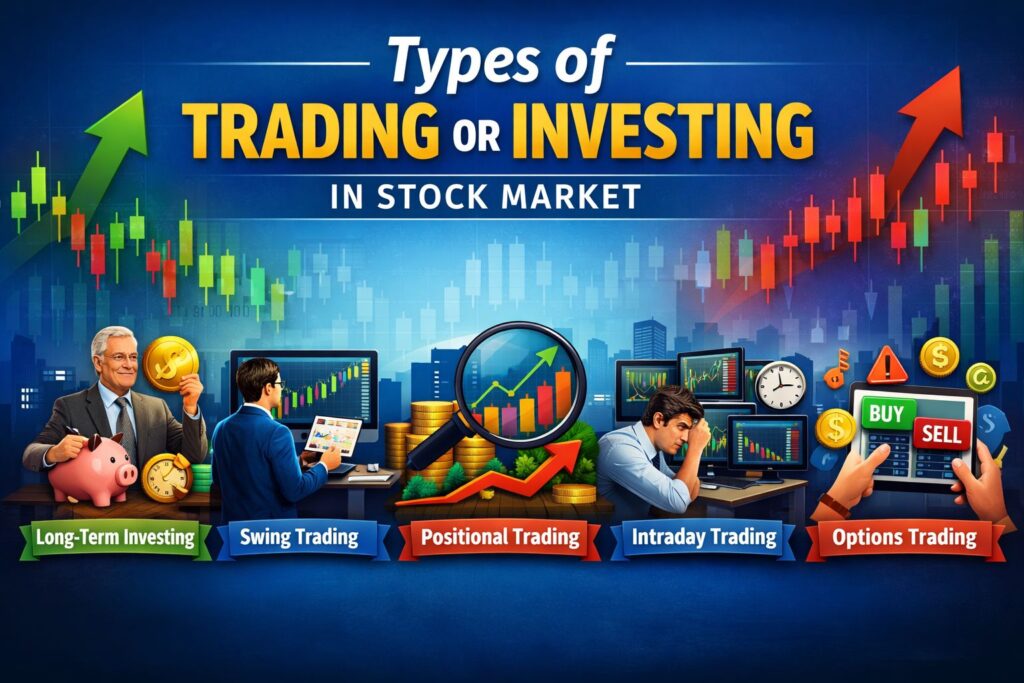
The main types include long-term investing, day trading, swing trading, position trading, scalping, options trading, momentum trading and dividend investing. Each differs by time horizon, risk level, and required capital.
1. Long-Term Investing
Time Horizon: Years to decades
Risk Level: Low to moderate
Best For:
- Patient individuals building wealth steadily.
- Long-term investing involves buying and holding assets like stocks, ETFs, or index funds.
- The goal is to benefit from compound growth and market appreciation over time.
- Popular approaches include value investing (Warren Buffett’s style) and buy-and-hold strategies.
2. Day Trading
Time Horizon: Minutes to hours
Risk Level: High
Best For:
- Experienced, active traders
- Day traders buy and sell securities within the same trading day, avoiding overnight risk.
- They rely on technical analysis, real-time charts, and volatility. Technical analysis is kind of market forecasting method.
- Success requires discipline, a solid strategy, and constant market monitoring.
3. Swing Trading
Time Horizon: Days to weeks
Risk Level: Moderate to high
Best For:
- Traders who can’t monitor markets all day
- Swing traders capture short- to medium-term price movements.
- They use technical and fundamental analysis to identify trends and hold positions for several days or weeks.
4. Position Trading
Time Horizon: Months to years
Risk Level: Moderate
Best For:
- Those with a macroeconomic outlook.
- Position traders hold assets based on long-term trends, often using fundamental analysis. This style is similar to investing but may involve more active management.
5. Scalping
Time Horizon: Seconds to minutes
Risk Level: Very high
Best For:
- Disciplined, high-frequency traders
- Scalpers profit from tiny price changes, executing dozens or hundreds of trades daily.
- This strategy requires advanced tools, low commissions, and intense focus.
6. Options Trading
Time Horizon: Varies (short to long)
Risk Level: High
Best For:
- Traders comfortable with derivatives
- Options trading involves contracts giving the right to buy/sell assets at set prices. Strategies range from conservative (covered calls) to high-risk (naked puts).
7. Momentum Trading
Time Horizon: Days to months
Risk Level: High
Best For:
- Traders who follow trends
- Momentum traders ride existing market trends, buying rising assets and selling falling ones. They use indicators like Moving Averages and RSI to confirm momentum.
8. Dividend Investing
Time Horizon: Years
Risk Level: Low to moderate
Best For:
- Income-focused investors
- Dividend investors buy stocks of companies that regularly pay dividends, generating passive income. This strategy prioritizes financial stability and consistent payouts. So first learn about What is Dividend?
Frequently Asked Questions:
Q1. What is the main difference between trading and investing?
A: Investing focuses on building wealth over years or decades by buying and holding assets like stocks, ETFs, or real estate. Trading aims to generate profits from short-term market movements, from seconds (scalping) to months (swing trading), with more frequent buying and selling.
Q2. Which trading style is more profitable?
A: More profits come from F& o and Intraday Trading. Profitability depends on your time, capital, risk tolerance, skills, and discipline. Long-Term Investing (Most Consistent for Most People)
Q3: How much money do I need to start?
A: Long-term investing: Can start with as little as 500 -1,000 Rupees.
Day trading: Minimum 1,000 Rupees enough for starting and small quantities.
Swing trading: It should be 10,000-20,000 Rupees recommended for proper position sizing.
Options trading: Varies by strategy, but 10,000 Rupees is a common starting point.
Q4: What’s the success rate for day traders?
SEBI Reports: 90% of day traders quit within two years· Only 10% are consistently profitable· Less than 1% achieve significant, long-term profits Success requires extensive education, discipline, and risk management.


Pingback: The 5 Best Trading Apps for Beginners in India - Stockmarket 360